
Franchise marketing is the system a franchisor uses to grow brand demand nationally while helping each franchise location win locally. A strong franchise marketing strategy connects corporate brand control, local market execution, lead generation, reputation management, franchise SEO, paid media , AI-enabled follow-up, and transparent reporting into one scalable growth engine.
That matters because franchising is still expanding. The International Franchise Association’s 2026 outlook projects U.S. franchise establishments will grow to 845,000 units and franchise employment will approach 8.9 million jobs. In a growing franchise economy, the brands that scale best will not simply advertise more. They will build stronger marketing systems.
For franchisors, the challenge is clear: every location needs local visibility, but the brand still needs consistency. Franchisees need leads, but corporate needs oversight. Marketing needs to move fast, but not become fragmented across disconnected vendors, inconsistent systems, and unclear reporting.
This guide explains what franchisors need to know about franchise marketing, what problems a strategy should solve, and how to build a repeatable system that supports both corporate growth and local franchisee success.

What Is Franchise Marketing?
Franchise marketing is the coordinated strategy used to grow a franchise brand while driving local demand for individual franchise locations. It includes both corporate-level marketing and local marketing execution.
In simple terms, franchise marketing has two jobs:
- Build trust and demand for the franchise brand as a whole.
- Help each local franchise location get found, chosen, and contacted by customers in its market.
A franchise marketing strategy usually includes national brand campaigns, local SEO for franchises, Google Business Profile optimization, paid search, social media, email and SMS follow-up, franchise lead generation, reputation management, content marketing, and performance reporting across locations.
The difference between ordinary digital marketing and franchise digital marketing is complexity. A single-location business can focus on one market. A franchise must balance brand consistency, local market variation, franchisee adoption, reporting, compliance, and scale.
Why Franchise Marketing Strategy Matters More as You Scale
Marketing often gets harder as a franchise grows. Early on, a small franchisor may rely on founder relationships, basic local ads, referrals, or a few strong operators. But once the network expands, small inconsistencies multiply.
A franchisor may start to see:
- Different locations showing up differently online.
- Incomplete listings, inconsistent hours, or outdated contact information.
- Franchisees running off-brand campaigns or not marketing at all.
- Uneven review volume and reputation quality across locations.
- Leads that are not tracked, answered, or followed up consistently.
- Marketing vendors working in silos without shared reporting.
- Corporate teams unable to see what is working by location, channel, or market.
At that point, the issue is not simply a marketing problem. It is a strategy and systems problem.
The goal of franchise marketing is not to replace local ownership. The goal is to give franchisees enough structure, tools, and support to execute well while giving the franchisor enough visibility and control to protect the brand and scale what works.
The Core Parts of a Franchise Marketing Strategy
A strong franchise marketing strategy should be built around the full franchise growth system, not isolated tactics. The most effective franchisors align these eight areas.
1. Brand Positioning and Messaging
Marketing often gets harder as a franchise grows. Early on, a small franchisor may rely on founder relationships, basic local ads, referrals, or a few strong operators. But once the network expands, small inconsistencies multiply.
A franchisor may start to see:
- Different locations showing up differently online.
- Incomplete listings, inconsistent hours, or outdated contact information.
- Franchisees running off-brand campaigns or not marketing at all.
- Uneven review volume and reputation quality across locations.
- Leads that are not tracked, answered, or followed up consistently.
- Marketing vendors working in silos without shared reporting.
- Corporate teams unable to see what is working by location, channel, or market.
At that point, the issue is not simply a marketing problem. It is a strategy and systems problem.
The goal of franchise marketing is not to replace local ownership. The goal is to give franchisees enough structure, tools, and support to execute well while giving the franchisor enough visibility and control to protect the brand and scale what works.
2. National Brand Control With Local Flexibility
Franchisors need to define what corporate controls and what local owners can adapt. Brand standards should cover logos, colors, offers, claims, service descriptions, approved messaging, review response tone, landing page templates, and creative guidelines.
The strongest franchise systems give franchisees room to localize without letting the brand fragment.
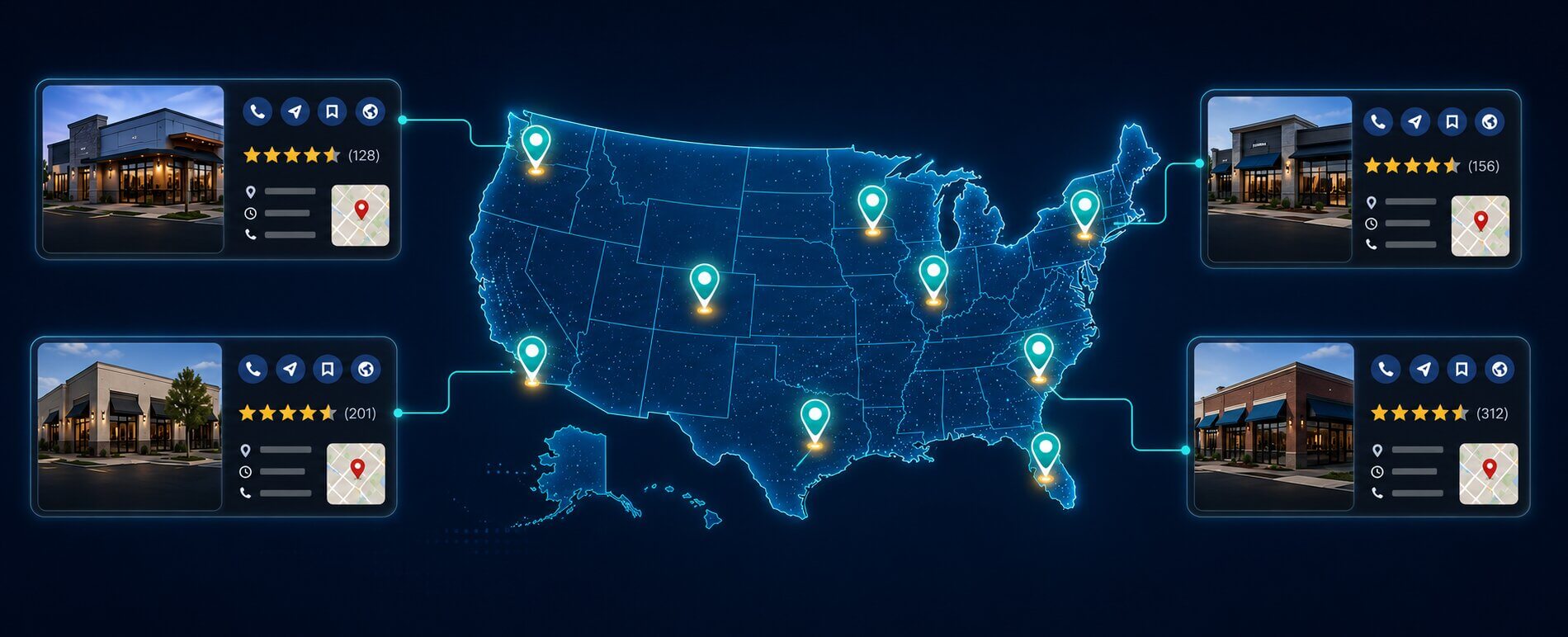
Local SEO for franchises is one of the most important foundations of franchise marketing because most franchise locations compete in local search moments. Customers often search by need, location, category, and urgency.
Google Business Profile is central to this process because it allows businesses to appear on Google Search and Maps, manage customer reviews, add updates, and provide accurate information that helps customers connect. Google specifically states that Business Profiles help businesses be found on Search and Maps and give owners control over photos, reviews, and business details.
For franchisors, the key is consistency. Every location should have an accurate name, address, phone number, website URL, categories, hours, services, photos, review response process, and tracking logic.
4. Reputation Management Across Locations
Reputation is not a soft metric. It directly influences whether prospects trust a local franchise location enough to call, visit, or book. BrightLocal’s 2026 Local Consumer Review Survey found that 97% of consumers read reviews for local businesses. It also found that 47% of consumers would not use a business with fewer than 20 reviews, and 74% only care about reviews written within the last three months.
For franchises, this means reputation management must be systematic. Review requests, review monitoring, review response, escalation rules, and location-level reporting should be part of the marketing system.
Strong reputation management helps franchisors see which locations are building trust and which need support before negative patterns damage the brand.
5. Franchise Lead Generation and Follow-Up
Franchise lead generation is not complete when the form is submitted or the phone rings. If calls are missed, inquiries are delayed, or leads are not followed up consistently, the system leaks revenue.
Franchisors should define how leads are routed, how fast each location must respond, what follow-up sequence should happen, and how corporate can see lead handling performance. This is where CRM workflows, call tracking, email and SMS automation, and AI-enabled support can become practical growth tools.
The question is not only “How do we get more leads?” A better question is “How do we make sure every valuable lead is captured, answered, nurtured, and measured?”
6. Content, Authority, and Franchise SEO
Franchise SEO services should support both the corporate website and local franchise pages. A strong content system can help the brand rank for national, regional, and local intent while giving franchisees assets that make them more credible in their markets.
Useful content may include service pages, local landing pages, FAQs, comparison content, industry education, case studies, videos, and blog articles that answer customer questions directly. This also supports AI visibility because generative search systems need clear, helpful, crawlable content to retrieve and summarize.
Google’s guidance for generative AI search says foundational SEO best practices still apply, and it emphasizes creating valuable, organized, people-first content supported by a clear technical structure.
7. Paid Media and Local Advertising
Paid search, social advertising, programmatic ads, and YouTube ads can help franchisors accelerate demand, but only if budgets, campaigns, tracking, and follow-up are aligned. Otherwise, franchise advertising can create spend without clarity.
A scalable franchise advertising strategy should answer:
- Which campaigns are funded by corporate and which are funded locally?
- Which locations need demand generation support first?
- Which markets have the best conversion economics?
- Which creative and offers are approved for local use?
- Which locations are wasting spend because follow-up is weak?
8. Reporting, Attribution, and Network-Wide Visibility
Franchisors need reporting that shows both the forest and the trees. Corporate should see network-level performance, while franchisees should understand what is happening in their own market.
Useful franchise marketing reporting should include location-level visibility into rankings, reviews, listings, calls, forms, paid media, cost per lead, conversion rate, lead follow-up, and revenue impact when available.
Without shared reporting, franchisors cannot confidently identify underperforming markets, replicate what is working, or prove the value of marketing support to franchisees.
Common Franchise Marketing Mistakes to Avoid
Many franchise systems underperform because they treat marketing as a collection of tasks rather than a coordinated system. Watch for these common mistakes:
- Letting each franchisee choose disconnected tools and vendors without shared reporting.
- Treating local SEO as a one-time setup instead of an ongoing process.
- Launching paid campaigns before lead tracking and follow-up are reliable.
- Using generic content that does not reflect customer questions or local market context.
- Ignoring reviews until reputation becomes a visible problem.
- Failing to define what franchisees own versus what corporate owns.
- Not measuring franchisee adoption or local execution quality.
- Reporting only channel metrics instead of business outcomes.
What KPIs Should Franchisors Track?
The right KPIs depend on the brand, industry, and sales cycle, but every franchise marketing strategy should include a mix of visibility, reputation, lead, conversion, and adoption metrics.
How AI Fits Into Franchise Marketing
AI should not replace franchise marketing strategy. It should help the system run faster and more consistently. For franchisors, AI is most useful when it supports repeatable workflows across locations.
Examples include:
- AI receptionists that help reduce missed calls and unanswered inquiries.
- AI-assisted review response workflows that help locations respond faster while maintaining brand tone.
- AI-powered content support for frequently asked questions, local updates, and customer education.
- CRM automations that route leads, trigger follow-up, and alert teams when action is needed.
- Reporting summaries that help corporate identify which locations need support.
The key is governance. Franchisors should define the standards, tone, escalation rules, and performance metrics. AI can help enforce and scale the process, but human judgment should still guide strategy, brand voice, and customer experience.
Franchise Marketing Agency vs. In-House Team
Franchisors often ask whether they should build an internal team or hire a franchise marketing agency. The answer depends on the complexity of the system, the number of locations, the internal team’s capacity, and how much execution support franchisees need.
An in-house team can be useful when the franchisor already has strong strategy, creative, operations, analytics, and local execution capabilities. A franchise marketing agency is often more valuable when the brand needs specialized support, multi-location reporting, paid media expertise, franchise SEO services, reputation management, and scalable execution across markets.
The strongest model is often hybrid: corporate leadership sets the business priorities, while a specialized agency helps build and operate the marketing system.
How Zero Company Approaches Franchise Marketing
Zero Company approaches franchise marketing as a growth system, not a pile of disconnected tactics. Our work is built around a simple idea: performance marketing should be measurable, transparent, and human-centered.
For franchisors, that means we help connect the pieces that often sit apart: brand strategy, local visibility, franchise SEO, paid media, reputation management, lead follow-up, reporting, AI-enabled workflows, and franchisee adoption. The result is a system designed to help each location perform better while giving corporate clearer visibility across the network.
What makes our approach different is how we combine data with empathy. We look at the customer behind the search, the franchisee behind the execution gap, and the franchisor behind the growth target. The objective is not just more clicks. The objective is stronger trust, better local performance, and scalable growth that franchise systems can actually sustain.
Zero Company can support franchisors through three practical service levels:
- The Foundation: for franchise systems that need every location to get found, look credible, and build trust.
- The Accelerator: for franchise brands ready to grow brand recognition, improve content visibility, and compete across local markets.
- The Enterprise: for growing franchisors ready to automate lead response, connect CRM workflows, and scale communication system-wide.
If your franchise system is dealing with inconsistent results, disconnected vendors, weak visibility, franchisee frustration, or missed lead follow-up, the right next step is not another random campaign. The right next step is a strategy that shows what to fix first and how to scale what works.
Here’s How to Evaluate Your Franchise Marketing System.
Use the checklist below to evaluate where your franchise marketing stands today.
- Corporate has a clear explanation of what the brand stands for and how every location should talk about it.
- Each location’s online information is accurate, including its Google Business Profile.
- Franchise owners know which marketing tasks they are responsible for in their local area.
- Customer reviews are regularly requested, checked, and responded to.
- Each location has website pages that clearly explain its services, location, and what customers are looking for.
- Advertising campaigns are connected to systems that track leads and help the team follow up.
- The CRM and call tracking systems show which leads are being answered and which ones turn into customers.
- Corporate can compare results across different locations, markets, and marketing channels.
- Franchise owners have access to approved marketing materials, images, content, and brand assets.
- AI or automation helps save time and keep things consistent, while people still review and guide the work.
- Reports show real business results, such as leads, calls, sales, or revenue, not just marketing numbers.
Want a copy to review with your team? Download the checklist as a PDF, or send it to your inbox for easy reference.
Email me the Checklist
Get the Franchise Marketing Strategy sent straight to your inbox so you can review it with your team anytime.
Ready to Turn Your Franchise Marketing Strategy Into Measurable Growth?
Fill out the form below to connect with our team and uncover opportunities to improve visibility, lead generation, brand consistency, and scalable performance across your franchise locations. Zero Company can help you turn marketing gaps into clearer priorities, transparent reporting, and systems built for more predictable growth.
LET'S FIND YOUR GROWTH GAPS AND BUILD YOUR
Franchise Growth Engine
Use the form to tell us what’s happening across your locations. We’ll help you uncover what’s working, what’s missing, and where to focus next.
Proven Systems
Full Transparency
Partner-First Approach
Conclusion: Franchise Marketing Works Best When It Becomes a System
Franchise marketing is not only about launching campaigns. It is about building a system that helps the franchisor scale the brand and helps every franchisee compete locally.
The best franchise marketing strategies create clarity around brand standards, local SEO, reputation management, paid media, content, lead follow-up, franchisee adoption, and reporting. They also give corporate teams the visibility to support underperforming locations and scale winning markets with confidence.
If you want to improve local visibility, build trust, reduce vendor complexity, support franchisees, and create a more scalable growth system, Zero Company can help you identify the right starting point.
Ready to build a franchise marketing strategy that connects, converts, and scales? Get a free consultation with Zero Company.
FAQ: Franchise Marketing Strategy
What is franchise marketing?
Franchise marketing is the strategy and execution used to grow a franchise brand at both the corporate and local levels. It includes national brand positioning, local SEO, paid media, reputation management, franchisee support, lead generation, reporting, and systems that help each location grow while staying aligned with the brand.
What should a franchise marketing strategy include?
A franchise marketing strategy should include clear brand guidelines, local marketing execution, franchise SEO, Google Business Profile optimization, paid media, review management, lead follow-up, franchisee adoption processes, and reporting across every location.
How can franchisors maintain brand consistency across locations?
Franchisors can maintain brand consistency by creating clear messaging standards, approved creative assets, local marketing playbooks, centralized reporting, and support systems that make it easier for franchisees to execute correctly.
Why is local SEO important for franchises?
Local SEO helps each franchise location appear when nearby customers search for products or services. It supports visibility in Google Search and Maps, improves local discovery, and helps franchisees compete in their own markets.
When should a franchisor hire a franchise marketing agency?
A franchisor should consider hiring a franchise marketing agency when local execution is inconsistent, franchisees need more support, reporting is fragmented, leads are not followed up consistently, or the internal team lacks the time or systems to scale marketing across locations.
Sources and Citations
- International Franchise Association, 2026 Franchising Economic Outlook: https://www.franchise.org/franchising-economic-outlook/
- Google Business Profile, Get listed on Google: https://business.google.com/us/business-profile/
- BrightLocal, Local Consumer Review Survey 2026: https://www.brightlocal.com/research/local-consumer-review-survey/
- Google Search Central, Optimizing your website for generative AI features on Google Search: https://developers.google.com/search/docs/fundamentals/ai-optimization-guide