Table of Contents
Why ETF Growth Starts With Belief
ETF issuers operate in one of the hardest marketing environments in asset management. You are not selling a low-consideration purchase. You are asking advisors, platforms, gatekeepers, and investors to trust a product that sits inside real portfolios and affects real money.
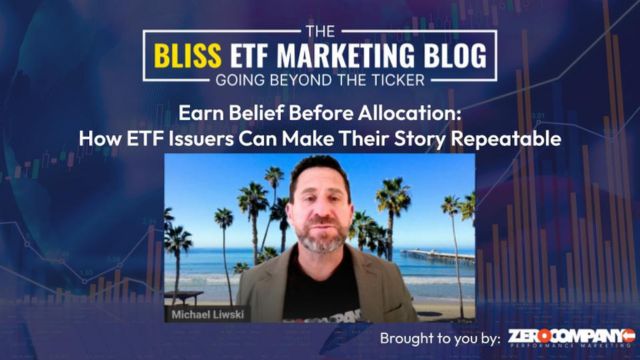
That is why the central idea in this episode matters: before an issuer earns allocation, it must earn belief.
In practical terms, that means ETF adoption does not usually start with louder promotion. It starts with clarity. A potential buyer or recommender has to understand what the fund is, who it is for, what problem it helps solve, and why it feels credible enough to recommend.
This is especially true in a market where product growth is real but attention is scarce. More launches, more active strategies, and more distribution complexity mean that explainability has become a real competitive edge.
You cannot buy adoption. In ETFs, you have to earn belief before you earn allocation.
That is the deeper BLISS lens here. Build Love Into Scalable Systems does not mean soft marketing. It means building a trust system that respects the audience, reduces confusion, and makes the next step feel safe.
Build Belief Before You Scale Demand
If growth feels harder than it should, the issue may not be reach—it may be message clarity.
Download the free ETF First-$100M Growth Checklist to assess whether your fund is building the trust, validation, and distribution conditions needed for early AUM momentum.
Why ETF Messaging Breaks
Most ETF messaging does not fail because teams are careless. It fails because the category naturally pulls marketers toward complexity.
A few patterns show up again and again:
- Funds get explained like prospectuses instead of decision-making tools.
- Teams lead with features, holdings, or index language before explaining who the fund is for.
- Compliance pressure turns clear language into vague language.
- Distribution, product pages, paid media, and PR tell slightly different stories.
- Paid campaigns amplify those inconsistencies rather than fixing them.
The result is not only weaker click-through rates or shorter visits. The larger problem is that confusion weakens trust.
When a product page says one thing, a sales deck implies another, and an ad introduces a third version of the story, the audience has to do the integration work. In ETF marketing, that is usually where belief breaks.
A strong ETF marketing strategy should help answer four questions fast:
- Who is this for?
- What problem does it solve?
- Why now?
- Why this issuer?
If your market cannot answer those questions quickly, more spend will not rescue the story.
The 3-Part Messaging System
The episode lays out a simple three-part system that can anchor ETF messaging across channels.
1. North Star
Your North Star is the core belief-driving idea behind the fund story.
For this show, the North Star is straightforward: Earn belief before you ask for allocation.
This is more than a tagline. It is a strategy filter. It forces teams to ask whether their messaging is reducing uncertainty or adding to it.
2. Operating Chain
The operating chain is the path the audience moves through:
Clarity leads to trust. Trust leads to adoption. Adoption contributes to AUM over time.
This matters because many ETF marketers jump straight to promotion before the clarity layer is strong enough to support it.
3. Memory Cue
The memory cue from the episode is simple and powerful:
Make your story repeatable.
If your own internal team cannot explain the fund consistently in 20 seconds, the market will not do it for you.
If your team cannot repeat the story clearly, the market will not repeat it either.
The Ladder From Facts to Meaning
One of the strongest ideas in the transcript is the ladder that turns ETF facts into meaning without hype.
Too many fund pages stop at the fact sheet level. They tell you what the fund holds, what methodology it uses, or how it is structured. Those facts matter, but facts alone do not create understanding.
The ladder is a better way to communicate:
What it is
Explain the exposure, process, or structure in plain language.
What it helps with
Clarify the job the ETF is meant to do in a portfolio.
What it changes
Show the practical portfolio impact. Does it simplify implementation? Help frame risk? Offer access in a cleaner format?
How it reassures
Explain why an advisor or investor can feel comfortable recommending it. This could come from transparency, process discipline, published methodology, fee clarity, or management credibility.
This framework is especially useful in regulated categories because it does not rely on hype. It relies on structure, plain English, and calm reassurance.
Do not stop at the fact sheet. Climb the ladder from facts to meaning.
How to Test Whether Your ETF Story Is Repeatable
A repeatable story is not a long narrative. It is a compressed, usable explanation.
The test from the episode is useful because it is simple.
Can your team explain the fund in:
- one sentence,
- three supporting bullets,
- and a clear next action?
A good one-sentence version should answer two things:
- who the fund is for,
- and what it helps with.
Then the three bullets should explain what makes the ETF distinct. That might be process, exposure, access, methodology, implementation benefit, or transparency.
Finally, the page or asset should tell the audience what to do next. Read the fact sheet. Review holdings. See methodology. Learn how it works. Understand how to invest.
This is not just a copywriting exercise. It is a distribution exercise. Advisors, internal sales teams, platform partners, and media contacts all need language they can reuse without distortion.
Can Your ETF Story Actually Be Repeated?
Most issuers don’t have a media problem. They have a repeatability problem.
Use our ETF Story Repeatability Scorecard (included inside the First-$100M Checklist) to pressure-test:
- One-sentence fund story clarity
- Advisor repeatability
- Product page friction
- Belief signal readiness
What the Product Page Must Do Above the Fold
The episode makes an important point that many ETF issuers overlook: the most critical part of the page is the confirm-and-act section above the fold.
A strong ETF product page should help a visitor answer a few questions fast:
- What is this fund?
- Who is it for?
- Why might it fit in a portfolio?
- What are the proof points?
- What should I do next?
A practical above-the-fold structure looks like this:
A human headline
Not prospectus language. Not institutional filler. Plain words that describe the fund in a way a real person can understand.
One line on fit
Explain who the fund is for, where it fits, and what problem it helps address.
Visible ticker and core facts
Make the ticker prominent. Include a few scannable facts that support quick comparison.
Three proof points
Use a small number of credible proof points such as exposure, methodology, fees, transparency, or construction process.
One clear CTA
The page should not force the visitor to guess what comes next. Offer one clean action such as getting the fact sheet, viewing holdings, learning how it works, or seeing how to invest.
This is how an ETF page starts to behave less like a document dump and more like an adoption asset.
How to Translate ETF Jargon Into Human Language
A major theme in the episode is translation. Not simplification in a misleading way. Translation in a way that preserves meaning while making it usable.
Here are examples of the kind of swaps described in the transcript.
Instead of “rules-based”
Say that the strategy follows preset written rules. Compare it to a recipe rather than a chef improvising.
Instead of “using options”
Explain that the fund uses contracts to help set guardrails around outcomes, with trade-offs and without removing risk.
Instead of “defined outcome period”
Say the strategy is designed to be understood over a set time window, not judged day by day.
Instead of “annual reset”
Explain that the terms refresh for the next period as contracts expire and market conditions change.
The point is not to strip out technical truth. The point is to make technical truth understandable enough that an advisor can say it out loud to a client with confidence.
Technical truth still has to be explainable truth.
How to Measure Belief When the Loop Is Not Closed
One of the clearest strategic points in the episode is that ETF marketing does not behave like e-commerce.
The journey is fragmented. Investors compare. Advisors validate externally. Platforms influence outcomes. Product discovery and decision-making often happen across places the issuer does not own.
So the goal is not to pretend every trade can be perfectly attributed back to a campaign.
The better question is this: are belief signals moving in the right order?
Qualified reach
Are the right people arriving from relevant searches, campaigns, and channels?
Engaged product-page behavior
Are visitors spending meaningful attention on the fund page rather than bouncing immediately?
High-intent micro-actions
Are people opening or downloading fact sheets, reviewing holdings, copying the ticker, comparing fees, or exploring methodology?
Email and asset engagement
Are audiences clicking through to the issuer’s core educational assets?
Directional confirmation
Do volume, flows, PR moments, distribution feedback, or platform conversations show signs of movement in the right direction?
This is a healthier measurement model because it respects ETF reality. It gives leadership a way to make decisions without relying on attribution theater.
Turn Belief Signals Into a Growth System
If you’re trying to connect messaging, search, product pages, and demand capture into a repeatable ETF growth engine, we can help.
Zero Company helps issuers build:
- ETF growth messaging systems
- Search and fund-page demand capture
- Belief-based measurement frameworks
- Distribution-aligned digital growth programs
What ETF Issuers Should Do Next
If you lead ETF marketing, this episode points toward a very practical next step.
Do not begin with another campaign.
Start by pressure-testing the story.
Ask whether your current messaging can do these five things:
- Explain the fund in plain language.
- Clarify who the fund is for.
- Translate facts into portfolio meaning.
- Give advisors language they can repeat.
- Create measurable belief signals before allocation happens.
If the answer is no, the growth bottleneck may not be media spend. It may be the messaging foundation underneath the spend.
That is the real takeaway from this conversation. In a crowded ETF shelf, clarity is not decoration. It is infrastructure.
And when that infrastructure is strong, everything else gets easier to scale: paid search, PR, product pages, education, distribution enablement, and internal reporting.
Conclusion
ETF growth is not only a distribution challenge or a media challenge. It is also a meaning challenge.
When a fund story is hard to understand, hard to retell, or hard to trust, growth friction increases at every stage of the journey.
But when issuers build messaging that is clear, calm, repeatable, and due-diligence friendly, they create better conditions for adoption.
That is how belief compounds.
That is how trust gets repeated.
And that is how stronger ETF marketing begins to support stronger long-term AUM outcomes.
FAQ
What does “earn belief before allocation” mean in ETF marketing?
It means ETF issuers must build trust and understanding before expecting adoption. Advisors and investors need to understand what the fund does, who it is for, and why it deserves consideration.
Why is repeatable messaging important for ETF issuers?
Repeatable messaging helps internal teams, advisors, distribution partners, and media contacts explain the fund consistently. Consistency reduces confusion and makes trust easier to build.
What should an ETF product page include above the fold?
A strong product page should include a plain-language headline, who the fund is for, where it fits, a few scannable proof points, a visible ticker, and one clear next action.
How can ETF marketers explain complex strategies more clearly?
Translate technical terms into plain language without removing important truth. Explain what the strategy does, what it helps with, what trade-offs exist, and how it should be evaluated.
What are belief signals in ETF marketing?
Belief signals are leading indicators that show trust and consideration are building. These can include qualified visits, fact sheet downloads, ticker copies, page engagement depth, and distribution feedback.
Why is ETF attribution difficult?
ETF adoption often happens across advisors, brokerage platforms, model portfolios, and off-site comparisons. Because the journey is fragmented, perfect trade-level attribution is usually unrealistic.
What is the messaging ladder for ETFs?
The ladder moves from what the fund is, to what it helps with, to what it changes, to how it reassures. It helps marketers move beyond fact-only communication.
What is the role of clarity in ETF growth?
Clarity reduces uncertainty. In ETF marketing, that makes it easier for advisors and investors to understand the product, compare it, and feel comfortable recommending or buying it.
Want a Fresh Set of Eyes on Your ETF Growth Story?
Request a Belief-to-AUM Messaging Review.
We’ll help pressure-test:
- Your fund story
- Product page clarity
- Search confirmation gaps
- Belief signals you may not be measuring